
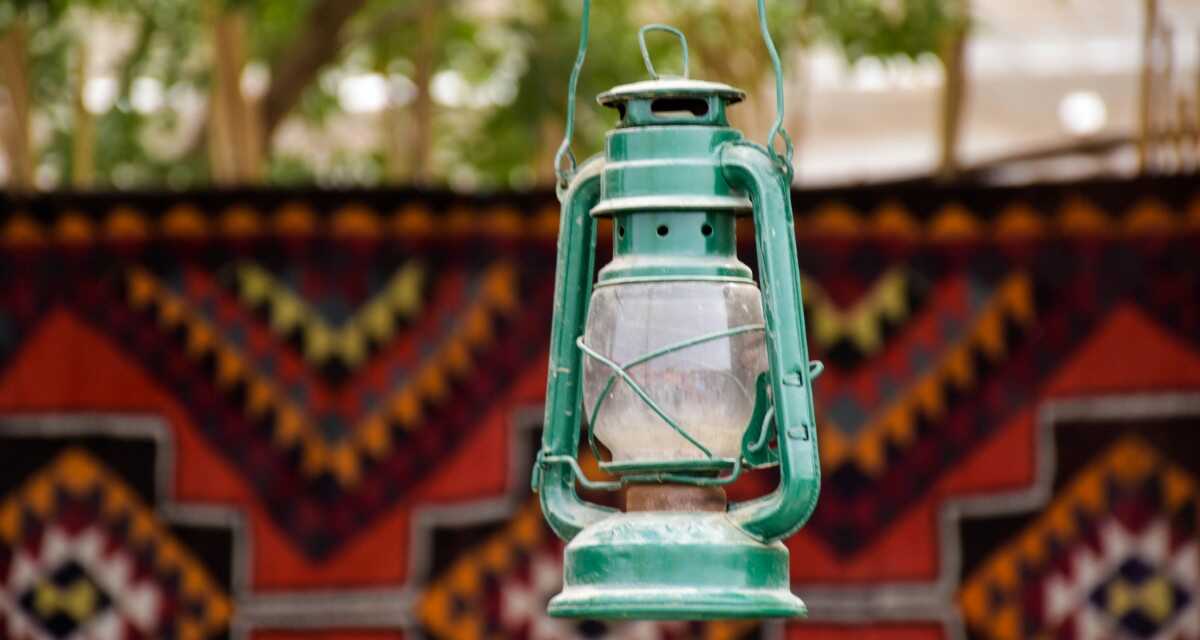
Here in Jordan a new tradition has appeared and become widespread, which is hanging electrically illuminated crescents and stars on the outside of buildings and balconies to celebrate the blessed month of Ramadaan, throughout the month. Is that permissible, seeing that it involves extravagance and imitation of the Christmas trees which Christians put up in December? Is the people’s ignorance a valid excuse?.
Praise be to Allaah.
Firstly:
We do not think there is anything wrong with putting up
decorations such as lanterns and the like to celebrate the beginning of the
blessed month of Ramadaan, but we should pay attention to a number of
things, such as the following:
1.
That should not be regarded as
an act of worship, rather it comes under the heading of permissible customs.
2.
We should not be extravagant
and buy these decorations for high prices.
3.
These decorations should not
include any images of animate beings or include any musical devices.
4.
The mosques should avoid using
such decorations, because they will distract worshippers.
The scholars of the Standing Committee were asked:
There is a custom in some mosques during the days of Eid and
Fitr and on other religious occasions of adorning the mosque with different
kinds of colours and lights and flowers. Does Islam allow such actions or
not? What is the evidence for it being permissible or otherwise?
They replied:
The mosques are the houses of Allaah, and they are the best
spots on earth. Allaah has given permission for them to be built and be
respected by proclaiming the Oneness of Allaah (Tawheed) and remembering
Him, and for prayer to be established in them, and for the people to be
taught about their religion in them and to be guided to that which will
bring them happiness in this world and in the Hereafter, by cleansing them
of abominations, idols, deeds of shirk, innovations and myths, and of filth
and dirt and impure things, and by protecting them against idle pursuits and
foolishness and raising voices, even if that is by making announcements
about things that have been found and asking about something that has been
lost, and other things that would make them like public streets and
marketplaces. And it is forbidden to bury people in mosques, or to build
mosques over graves, or to hang up pictures in mosques or draw pictures on
their walls, and other things that would promote shirk or distract those who
are worshipping Allaah therein and contradict the purpose for which they
were built. The Prophet (peace and blessings of Allaah be upon him)
paid attention to these matters, as is well known from his life story and
his actions, and he taught them to his ummah so that they would follow his
teachings and respect the mosque and take care of the places that were built
to establish the rituals of Islam. By doing that, they are following the
example of the Messenger (peace and blessings of Allaah be upon him),
and there is no report from him (peace and blessings of Allaah be upon
him) which says that he venerated the mosque by illuminating it or putting
flowers in it on Eids and special occasions. That was not known at the time
of the Rightly-Guided Caliphs either or the time of the guided rulers during
the early generations which the Prophet (peace and blessings of Allaah
be upon him) testified are the best of generations, even though the people
advanced and became very wealthy, and they developed a fine civilization and
adopted all kinds of adornment and colours during the first three centuries.
All goodness is in following the guidance of the Prophet (peace and
blessings of Allaah be upon him) and that of the Rightly-Guided Caliphs who
came after him, and those rulers who followed their way after them.
By hanging lamps on them or putting electric lights around
the outside or on the minarets, and hanging up flags and banners, and
putting flowers on them on Eids and special occasions to decorate them and
venerate them is an imitation of what the kuffaar do with their churches and
places of worship, and the Prophet (peace and blessings of Allaah be
upon him) has forbidden imitating them in their festivals and worship. End
quote.
Fataawa Islamiyyah (2/20, 21)
If the lighting in the mosque is sufficient there is no
legitimate reason for adding anything else that serves no purpose, and that
money should be used for something else.
Majmoo’ Fataawa Ibn Taymiyah
(31/206).
Secondly:
It should be noted that taking the star and crescent as a
symbol of the Muslims has no basis in sharee’ah, and it was not known at the
time of the Prophet (peace and blessings of Allaah be upon him) or the
time of the Rightly-Guided Caliphs, or even at the time of the Umayyads.
Rather it was introduced after that. Whatever the case, flags and banners
should be in accordance with sharee’ah, and as there is no evidence that
this (the crescent and star symbol) is prescribed in Islam, it is better to
avoid it. The crescent and star is not a symbol of the Muslims, even though
some Muslims have adopted it.
This has also been discussed in the answer to question no.
1528.
And Allaah knows best.


