
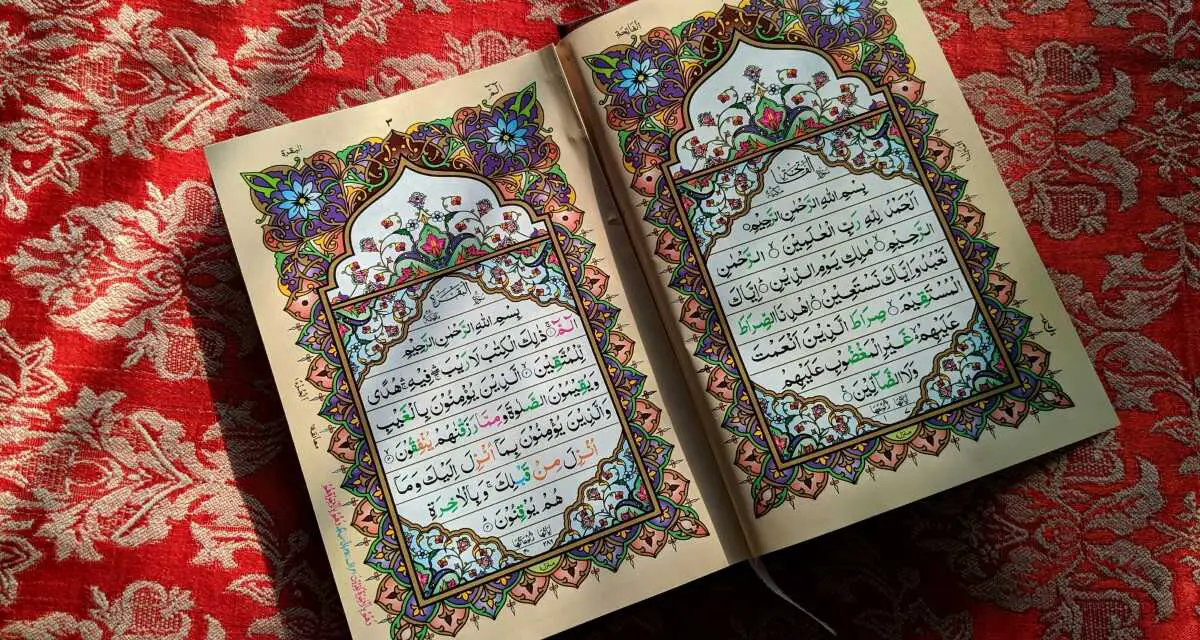
Unfortunately I received this message on WhatsApp: They asked a foolish man who was fasting: Which soorahs of the Qur’an do you like best in Ramadan? And he said: al-Maa’idah [the word may be understood to refer to a table laden with food], ad-Dukhaan [lit. smoke, but in modern Arabic the word is used to refer to cigarettes and the like] and an-Nisa’ [women]. Can you explain the ruling on this joke?
Praise
be to Allah
The words quoted
constitute a grave evil and ridicule of the words of Allah, may He be
exalted, which is the greatest and noblest of speech; the one who ridicules
His words is a disbeliever who is subject to a stern warning, as Allah, may
He be exalted, says (interpretation of the meaning):
“The
hypocrites are apprehensive lest a surah be revealed about them, informing
them of what is in their hearts. Say, ‘Mock [as you wish]; indeed, Allah
will expose that which you fear.’
And if you ask
them, they will surely say, ‘We were only conversing and playing.’ Say, ‘Is
it Allah and His verses and His Messenger that you were mocking?’”
[at-Tawbah
9:64-65].
No one falls
into this except fools who have the audacity to transgress the limits set by
Allah, claiming that they are just joking and having fun, like those
concerning whom this verse was revealed.
Imam at-Tabari
narrated in his Tafseer (14/333) from Sa‘d, from Zayd ibn Aslam, that
one of the hypocrites said to ‘Awf ibn Maalik during the Tabook campaign:
What is the matter with these Qur’an reciters of ours, who love food the
most out of all of us, are the worst liars among us and the most cowardly at
the time of battle?! ‘Awf said to him: You are lying, but you are a
hypocrite; I shall surely tell the Messenger of Allah (blessings and peace
of Allah be upon him) about what you have said. ‘Awf went to the Messenger
of Allah (blessings and peace of Allah be upon him), to tell him, but he
found that the Qur’an had preceded him. Zayd said: ‘Abdullah ibn ‘Umar said:
I saw that man, hanging onto the girth [strap holding the saddle on] of the
she-camel of the Messenger of Allah (sa) (blessings and peace of Allah be
upon him), stumbling over the stones and saying: “We
were only conversing and playing”
[at-Tawbah 9:65], and the Prophet (blessings and peace of Allah be upon him)
said to him: “Is
it Allah and His verses and His Messenger that you were mocking?”
[at-Tawbah 9:65].
Abu Bakr ibn
al-‘Arabi (may Allah have mercy on him) said in his Tafseer (2/543):
What they said was either said in earnest or in jest; whatever the case, it
constitutes disbelief (kufr), for uttering the word of disbelief in jest is
still disbelief, and there is no dispute concerning that among the ummah.
Saying something in earnest and meaning it is akin to truth and knowledge,
and saying something in jest is akin to falsehood and ignorance. End quote.
These great
soorahs [referred to in the so-called joke] contain rulings, decrees and
exhortation; the believer loves them because they are the words of Allah,
not because they mention the table (that is, food) or women, let alone
making a connection between the fasting person and that which is forbidden
to him (during the fast) of food and sex.
Moreover, this
reprehensible joke is a distortion of the meanings of the words of Allah,
misinterpreting them to make them refer to something that is hated and
prohibited. The dukhaan (smoke) referred to in the soorah is one of the
signs of the Hour; the word does not refer to tobacco or cigarettes [as is
the usage of the word dukhaan in modern Arabic], which this man and his ilk
consume and this evil mocker wishes to have.
Allah, may He be
exalted, says (interpretation of the meaning):
“Then
watch for the Day when the sky will bring a visible smoke
Covering the
people; this is a painful torment.
[They will say],
‘Our Lord, remove from us the torment; indeed, we are believers.’
How will there
be for them a reminder [at that time]? And there had come to them a clear
Messenger”
[ad-Dukhaan
44:10-13].
What the one to
whom this message was sent should do is denounce it, and advise the one who
sent it to him; he should not forward it to anyone, because of what it
contains of disbelief in Allah, may He be exalted, and ridicule of His word.
What he must do
is beware of the harvest of the tongues, for a word may cause a person to
fall in hell a distance greater than that between the east and the west.
Al-Bukhaari
(6478) and Muslim (2988) narrated from Abu Hurayrah that he heard the
Messenger of Allah (blessings and peace of Allah be upon him) say: “A person
may say a word that is pleasing to Allah, not paying it any heed, for which
Allah will raise him several degrees in status, and a person may say a word
that is displeasing to Allah, not paying it any heed, for which he will fall
into Hell.”
Al-Bukhaari
(6477) and Muslim (2988) narrated from Abu Hurayrah that he heard the
Messenger of Allah (blessings and peace of Allah be upon him) say: “A person
may say a word, not realizing its repercussions, for which he will be thrown
down into Hell further than the distance between the east and the west.”
At-Tirmidhi
(2319) and Ibn Maajah (3969) narrated that Bilaal ibn al-Haarith al-Muzani,
the Companion of the Messenger of Allah (sa) (blessings and peace of Allah
be upon him) said: I heard the Messenger of Allah (blessings and peace of
Allah be upon him) say: “One of you may speak a word that pleases Allah, and
not know how far it reaches, but because of it Allah will decree that He is
pleased with him until the Day he meets Him. And one of you may speak a word
that angers Allah, and not know how far it reaches, but because of it Allah
will decree that He is angry with him until the Day he meets Him.”
Classed as
saheeh by al-Albaani in Saheeh at-Tirmidhi.
We ask Allah to
keep us safe and sound.
It should be
noted that saying words of disbelief by way of joking constitutes disbelief,
according to scholarly consensus, as quoted above from Ibn al-‘Arabi. It is
not stipulated that the person who says or does that should have the
intention of mocking (Islam or the Qur’an).
Shaykh Ibn
‘Uthaymeen (may Allah have mercy on him) said: There are three levels. The
first level is saying words, intending thereby to revile Islam in a
deliberate action, as the enemies of Islam do when they revile Islam.
The second level
is saying words deliberately without the intention of reviling Islam. In
other words, intending to say such words without intending to revile; rather
the speaker is joking and is not serious. In this case the ruling is the
same as in the first case: the one who says such things is a disbeliever,
because he is still ridiculing and mocking Islam.
The third level
is when the speaker does not intend to say the words or to revile Islam;
rather it is a slip of the tongue that caused him to say words that could be
reviling Islam, without intending to do so at all. The speaker did not
intend to say those words or to revile Islam. In this case he is not to be
taken to account for it, and this is included in the meaning of the verse in
which Allah, may He be exalted, says (interpretation of the meaning):
“Allah
will not impose blame upon you for what is meaningless in your oaths”
[al-Maa’idah 5:89].
This is like when a man says whilst talking, “No, by Allah; yes, by Allah” –
he does not intend to swear an oath, so it does not come under the same
ruling as an oath that is uttered deliberately. Whatever a person says
without meaning to say it is not subject to any ruling.
End quote from
Fataawa Noor ‘ala ad-Darb.
And Allah knows
best.


